
Callanish Stones
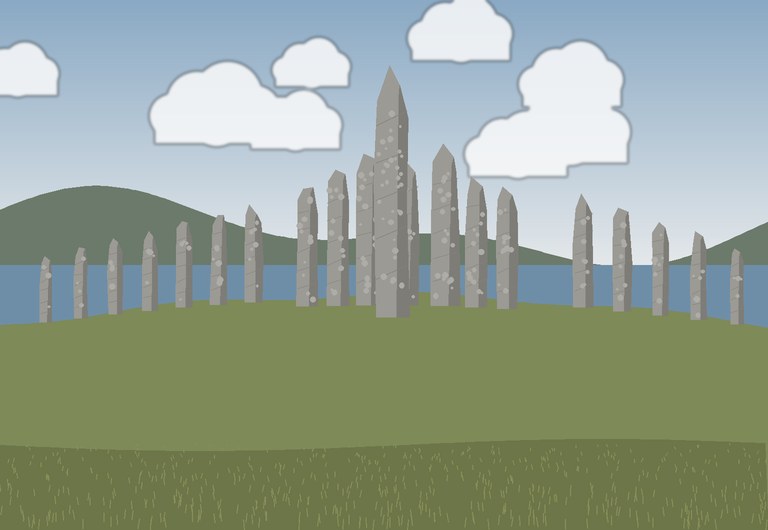
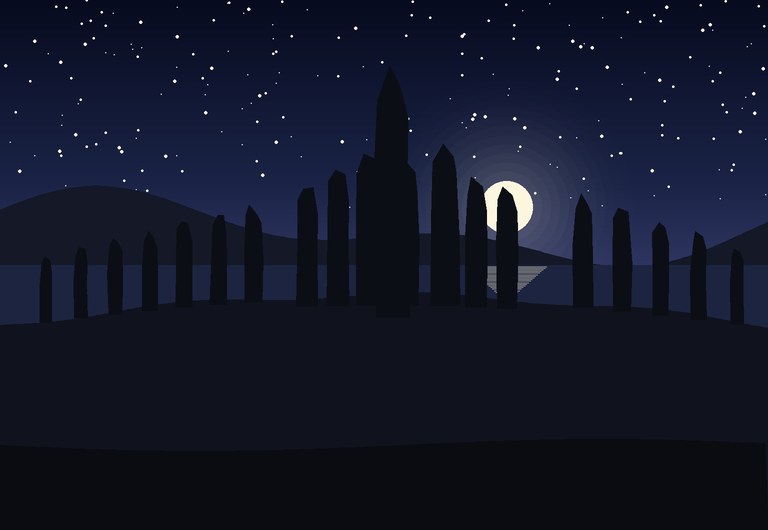
Drag across the picture to compare the two views.
The Callanish Stones, in Gaelic Calanais, stand on a low ridge above Loch Roag on the Isle of Lewis, in Scotland’s Outer Hebrides. Tall, thin and silver-grey, they are among the most atmospheric prehistoric monuments in Europe.
A cross of stone
The stone circle was put up between about 2900 and 2600 BC. Thirteen stones form a ring about 11 metres across, and in the middle rises a single monolith 4.8 metres tall, shaped a little like a ship’s rudder. Rows of stones run out from the circle, including a long avenue to the north. Seen from above, the whole setting looks like a Celtic cross.
All the stones are Lewisian gneiss, a local rock that is one of the oldest in Britain, with a beautiful streaked grain. Later, a small chambered tomb was built inside the circle.
Buried and rediscovered
People used the site for many centuries. Later it was slowly covered by peat. In 1857 about 1.5 metres of peat was cleared away, showing the full height of the stones for the first time in thousands of years.
Some researchers link Callanish with the Moon. Every 18.6 years, at the major lunar standstill, the Moon rises and sets unusually low over the southern hills, appearing to skim along the horizon. Drag the picture above to see a moonrise over the stones.
Visiting tips
- The stones are open at all times. A visitor centre nearby tells their story.
- Visit the smaller circles close by, known as Callanish II and III.
- The weather changes fast on Lewis. Bring a warm, waterproof layer even in summer.
Key facts
| Location | Isle of Lewis, Outer Hebrides, Scotland |
| Built | c. 2900–2600 BC |
| Central circle | 13 stones, about 11 m across |
| Central monolith | 4.8 m tall |
| Rock | Lewisian gneiss |
| Peat removed | 1857 |
Where it sits in time
Callanish Stones: c. 2900–2600 BC ·
Orange: this site. Grey: other sites. Lines: pyramids and early writing. Full timeline →