
Newgrange
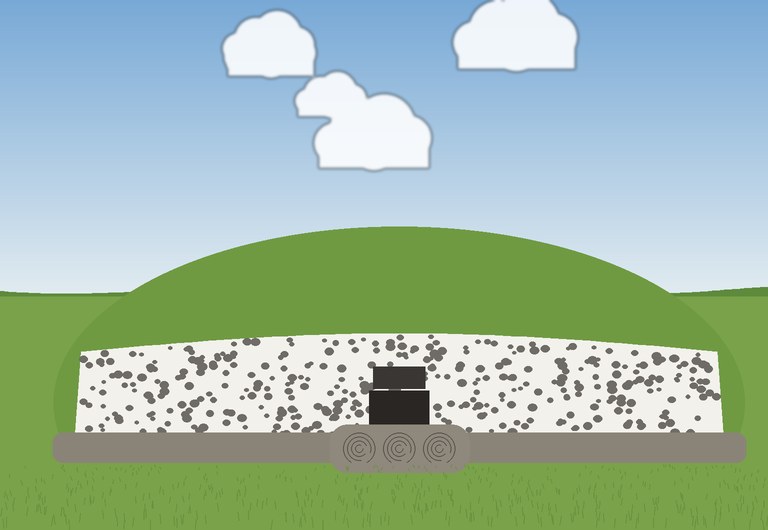
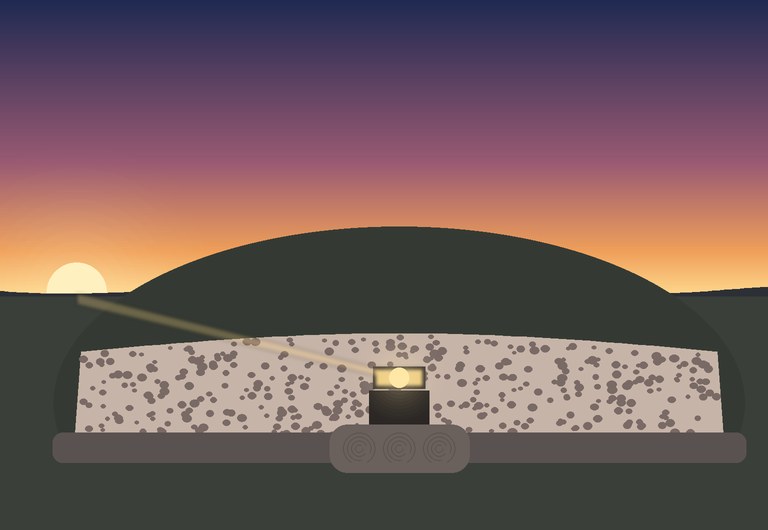
Drag across the picture to compare the two views.
Newgrange, in County Meath in Ireland, is a huge round mound built around 3100 BC. That makes it older than the Great Pyramid of Giza and older than the stone circle of Stonehenge. It is part of Brú na Bóinne, a landscape of ancient monuments in a bend of the River Boyne.
A mound of stone and earth
The mound is about 85 metres wide and 12 metres high. Around its base runs a ring of large kerbstones, many of them decorated with carved spirals, zigzags and circles. The great entrance stone, covered in carved spirals, is one of the finest pieces of Neolithic art in Europe. The front of the mound is faced with white quartz and dark rounded stones.
The light of midwinter
A 19-metre passage leads into a cross-shaped chamber at the heart of the mound. Above the entrance is a small opening called the roof-box. On the mornings around the winter solstice, the rising sun shines through the roof-box, along the passage and into the chamber, lighting it for about 17 minutes. Drag the picture above to see the midwinter dawn.
Each year a free lottery chooses a small number of people to be inside the chamber at the solstice.
Visiting tips
- Newgrange can only be visited on a guided tour starting at the Brú na Bóinne Visitor Centre.
- During the tour, guides recreate the solstice light inside the chamber with a lamp.
- Tours are popular in summer, so book early.
Key facts
| Location | Brú na Bóinne, County Meath, Ireland |
| Built | c. 3100 BC |
| Mound | About 85 m wide, 12 m high |
| Passage | 19 m long |
| Solstice light | About 17 minutes at midwinter dawn |
| UNESCO World Heritage | Since 1993, as Brú na Bóinne |
Where it sits in time
Newgrange: c. 3100 BC ·
Orange: this site. Grey: other sites. Lines: pyramids and early writing. Full timeline →